Top 20 Best Firm for Data Scientists to Work For 2026
For seven years, AIM's Best Firms certification has evaluated where India's data scientists should work. This year, we changed the question. Instead of asking only what companies offer, we asked what employees actually experience.
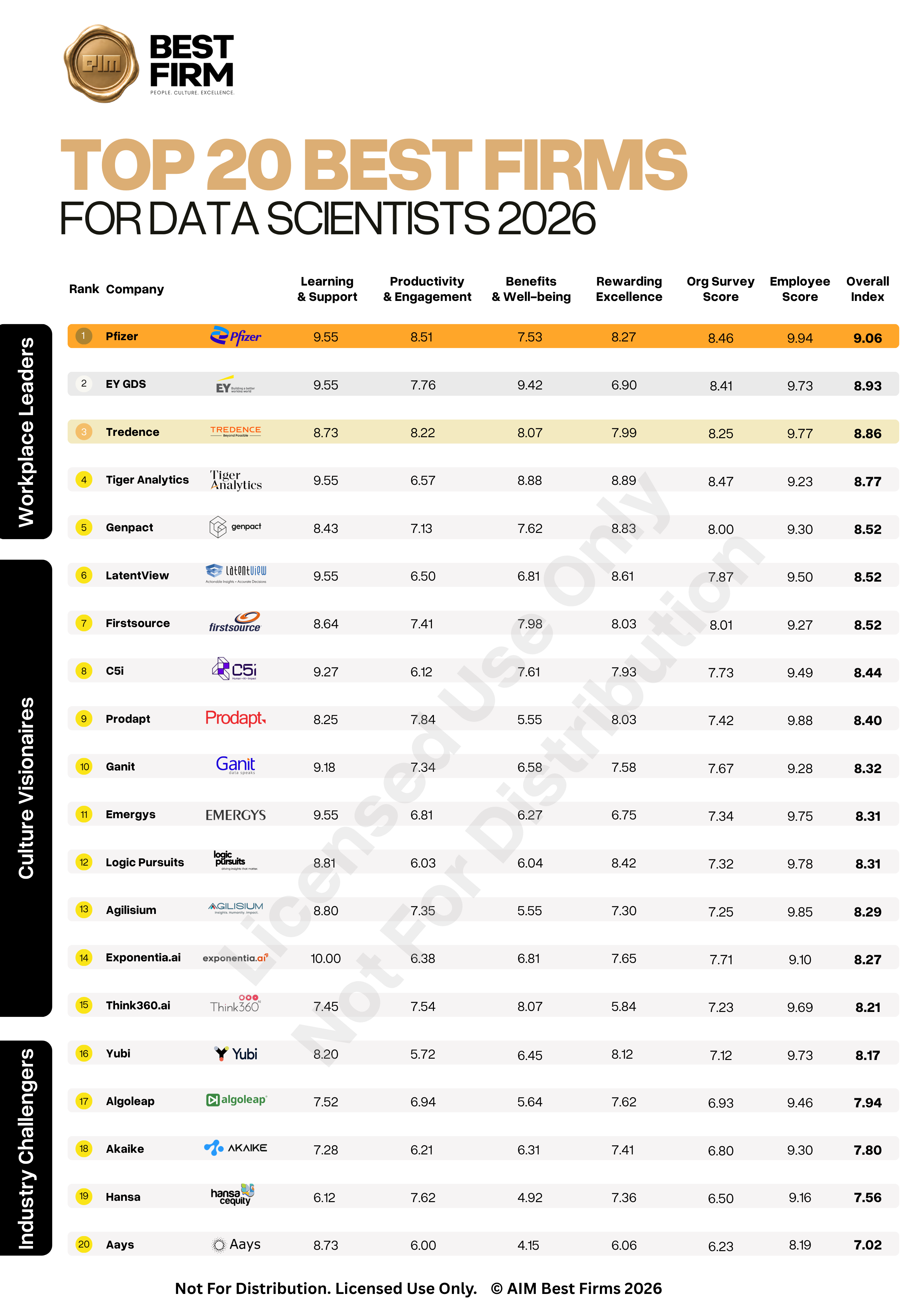
The 8th annual edition introduces a fundamental shift: for the first time, over 1,600 Data & AI professionals participated in an anonymous employee survey that carries 40% weight in the final ranking. The remaining 60% comes from a structured Organizational Survey, evaluated across four dimensions: Learning & Support, Productivity & Engagement, Benefits & Well-being, and Rewarding Excellence.
The employee survey captures day-to-day reality across five dimensions: Alignment, Execution & Accountability, Growth & Learning, Inclusion & Belonging, and Psychological Safety. The result is a ranking that reflects not just policy breadth, but lived experience.
The Top 20 Ranking
Leading Trends Across the Top 20
1. Certification is Now Universal
95% of ranked firms provide certification opportunities across cloud and data platforms including AWS, Azure, GCP, Databricks, and Snowflake. Leading companies have gone further, adding LLM-specific certifications to the stack. Generative AI fluency is no longer a nice-to-have. It's becoming a baseline expectation, and the best employers are funding the path to get there.
2. Talent is Growing, and It's Staying
Ranked firms report an average 34% headcount growth in Data & AI roles over the past 12 months, with 19 of 20 companies actively expanding their teams. At the same time, average attrition across the cohort sits at 8.5%, well below the industry norm for Indian tech. Several firms report sub-6% voluntary attrition, with the lowest at 1.6%.
When growth is high and attrition is low, companies are genuinely scaling, not just replacing departures. The data backs this up.
Tenure adds another layer. Half the cohort reports 3 to 5 year average tenure, signalling stable and retained teams. The other half reports 1 to 3 years, but not because people are leaving. In fast-growing companies, rapid hiring naturally dilutes average tenure even when retention is strong. A firm growing 40% year-on-year with 6% attrition will always show shorter tenure on paper. That's a growth signal, not a warning sign.
3. 360° Feedback Has Become Standard
90% of ranked companies now run multi-source feedback in some form. What's changed is how it's used. Over half have tied it directly to performance appraisals, making peer and stakeholder feedback a real factor in career progression rather than a developmental exercise with no stakes.
4. Recognition Has Gone Continuous
50% of companies now recognise Data & AI professionals on a monthly cadence, with another 30% doing so quarterly. The old model of one annual awards ceremony is being replaced by a steady rhythm of real-time recognition that reinforces performance as it happens. The best firms in this cohort recognise their people roughly ten times a year.
5. Benefits Separate the Leaders from the Pack
Learning & Support scores are strong across the board, with 15 of 20 companies scoring above 8.0 out of 10. It's not where rankings are won. Benefits & Well-being is. This section carries the highest variance in the entire assessment. Companies that report comprehensive health coverage, flexible work arrangements, and structured burnout prevention measures consistently rank higher than those that don't. The gap between the top and bottom of this section is wider than in any other dimension, making it the single biggest differentiator in the 2026 ranking.
6. Employee Voice Enters the Equation
This is the first year the ranking incorporates direct employee feedback at scale. Across 1,600+ respondents, the average positive approval rating stands at 94%.
The strongest signal comes from Alignment, where employees across the cohort report a clear understanding of their roles, how their work connects to business outcomes, and confidence in the direction their company is headed. Inclusion & Belonging also scores high across the board, with the majority of respondents affirming that they feel respected, fairly treated, and proud to be part of their organisations.
Where employees are most discerning is Growth & Learning. Questions around structured career paths, access to mentors, and long-term career confidence show the widest spread across companies. This is where the difference between a good employer and a great one becomes visible. Companies investing in formal learning plans, mentorship programmes, and internal mobility see it reflected directly in how their people respond.
Psychological Safety, covering management trust, openness to feedback, and comfort with honest mistakes, rounds out as a consistently strong dimension, though it also surfaces the clearest gap between top-tier and lower-ranked firms.
The takeaway is simple. Policies and infrastructure get companies into the conversation. But it's the employee experience, measured anonymously and at scale, that determines where they land.
AIM's Best Firms Certification is the gold standard for recognising tech and AI workplaces that lead on culture, talent development, and employee experience, now backed by structured employee feedback alongside industry benchmarking. Earning the badge helps you attract and retain top Data Scientists, AI Engineers, and Data Engineers, signal workplace excellence, and gain actionable insights to strengthen retention, inclusion, and governance.

About Shreyanshu Dey
Shreyanshu works at the intersection of marketing and marketing research at AIM, building the frameworks and benchmarks behind the Best Firm certification program. His work spans survey methodology, employer sentiment analysis, and the outreach and content that bring those findings to a wider audience.