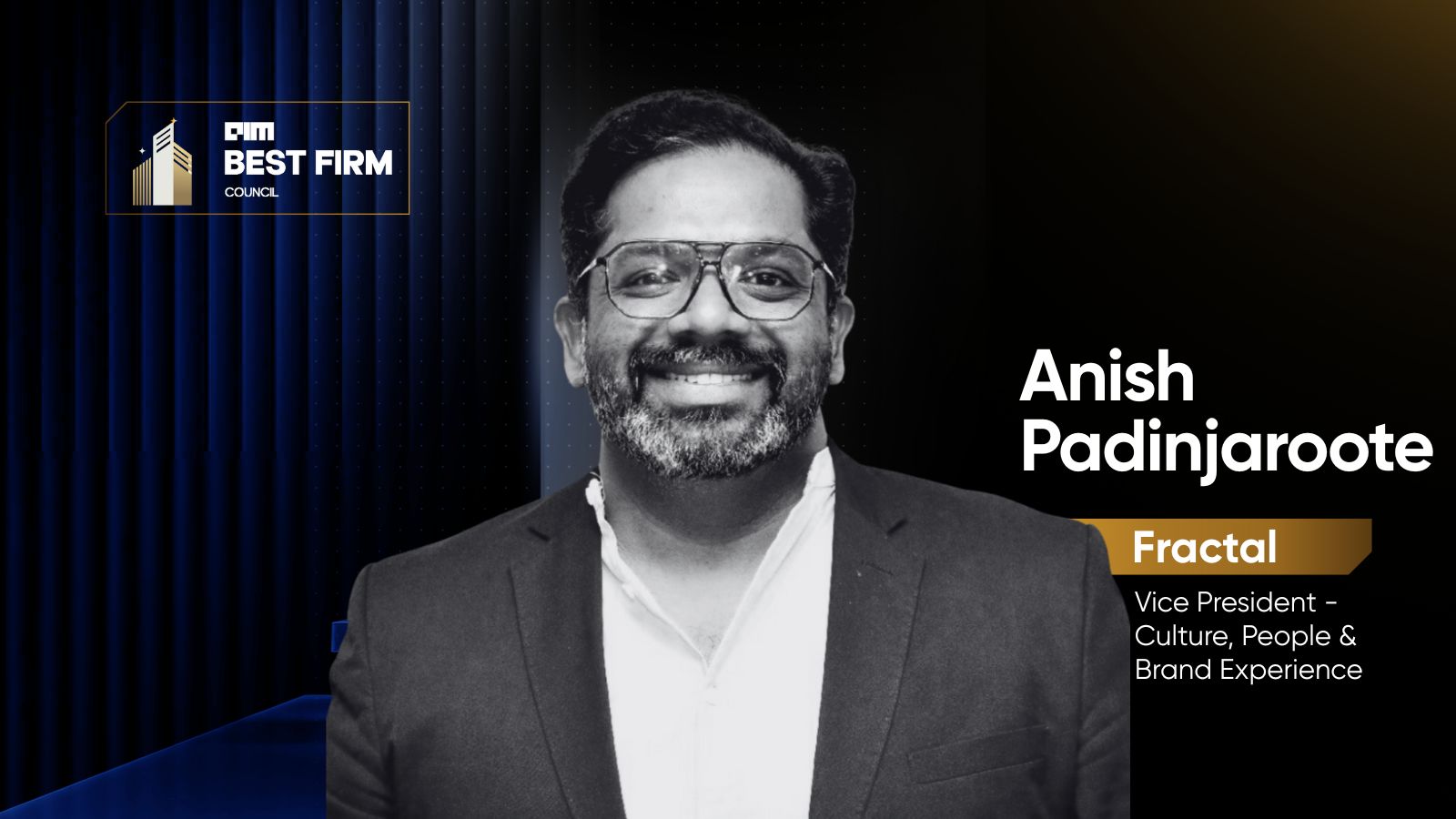
HR Vision Talk: Anish Padinjaroote on Culture and Clarity
When Anish Padinjaroote talks about culture, he does not begin with values and slogans, but with a tension he has seen many times in fast-scaling tech organisations.
Growth accelerates, structures multiply, and teams specialise, but for the people inside, direction becomes harder to read. Managers interpret decisions differently. Culture statements circulate widely, yet day-to-day behaviour varies sharply from one team to another. In many data and analytics organisations, the work moves faster than the systems meant to guide it.
“It is not that leaders do not communicate,” he said. “It is that communication is not interpreted the same way.”
As Vice President for Culture, People and Brand Experience at Fractal, Anish works inside this tension. His remit covers communication, leadership behaviour and the employee experience across a global organisation that has expanded through new markets, new lines of business and several acquisitions. His worldview comes less from HR orthodoxy and more from years spent moving across functions and geographies, watching how people, processes and choices either enable scale or quietly impede it.
His approach rests on a few fundamentals. Use simple language. Build confidence in the middle layer. Design for context instead of copying best practices. Make culture practical rather than aspirational. These ideas guide how he sees leadership in high-change technology environments where organisation charts evolve faster than behaviours settle.
The Discipline of Communication and the Role of the Middle Layer
Anish is sure about where scaling companies struggle.
“As companies grow, language becomes the first source of friction,” he said. Smaller teams rely on proximity and resolve ambiguity in real time. Once organisations expand, unclear language slows execution more than any structural issue.
For him, communication is a discipline, not a hygiene task, and the true stabiliser is not the executive team. It is the middle.
“The middle layer has to manage up and lead down,” he said. He calls this layer the crux because it is where alignment either holds or breaks. This group interprets decisions, explains priorities and absorbs constant shifts. When this layer is confident and clear, teams adapt without losing direction. When it is not, organisations appear busy but move unevenly.
This belief informed his early startup, which focused on helping managers grow through real experiences rather than disconnected workshops. The same belief guides how he builds systems at Fractal today. Policies stay minimal. Decisions must be grounded in the principles behind them. Leaders communicate weekly about priorities and the reasoning behind choices. Rituals stay consistent so they can anchor teams regardless of pace.
Cultural alignment, in this model, comes from communication discipline, not slogans or posters.
Why Context Matters More Than Best Practices
Few leaders challenge the idea of best practices as openly as Anish.
“I hate the word best practice,” he said. “Whatever works for one company may not work for another.”
He sees culture as personal. Employees arrive with reference points influenced by geography, previous workplaces, upbringing and individual values. These combine to form microcultures that are real, influential and often invisible. The goal is not to erase them but to design around them.
“An organisation is a collective of humans coming together to create magic through a vision,” he said. “Uniformity leads to monoculture. That becomes policing.”
This view becomes crucial in global organisations that grow through acquisitions. At Fractal, acquired companies arrive with their own history, rhythm and norms. Instead of forcing assimilation, the organisation relies on three anchors. Values. People principles. Leadership code. Everything else adapts to geography, business model or identity.
It reduces cultural displacement. Incoming teams do not have to abandon their microcultures. They only need to connect them to shared principles. For Anish, this is what makes culture humane. Flexibility with boundaries, not standardisation with slogans.
His resistance to copying frameworks comes from experience. Imported models often create more friction than alignment. Culture works only when designed for the people who must live it.
Operationalising Culture, Not Announcing It
Anish rejects culture as a symbolic idea.
“Culture must be operationalised. It is not something you just talk about,” he said.
Values matter only when they guide decisions. Principles matter only when leaders refer to them. Leadership expectations matter only when behaviour reflects them across teams.
Policies should be trust-based. Structures should aim for clarity rather than expansion. Leadership expectations should stay simple so they can be interpreted without confusion. As the organisation grows and its memory resets through attrition, new hires and acquisitions, these anchors prevent drift.
Leadership, in his view, is the stabiliser. Leaders must communicate transparently, explain the principles behind decisions and trust the expertise they hire. Too much control slows teams. Confidence in people creates momentum.
“You hired them because you needed that expertise,” he said.
His view extends into the future of work. As tools take on more routine tasks, roles will move toward experience building. People will focus on collaboration, connection and clarity, supported by systems that handle execution.
Culture, in this world, becomes a continuous act of design. A recurring practice formed by how leaders behave, how teams interpret decisions and how organisations respond to complexity.
And for Anish, that practice ends where it begins. With one belief, he repeats often. “Happy managers make happy employees make happy clients make a happy company.”

About Mansi Mistri
Mansi is a writer who enjoys breaking down complex topics into simple, readable stories. She is curious about how ideas move through people, platforms, and everyday conversations. You can reach out to her at [email protected].